This is usually the first question a shop owner asks, right after "does this actually work." Fair question, and most answers online are either a vague "it depends" or a suspiciously specific number that has nothing to do with your shop, pulled from the same place as a "check engine light means exactly one thing" article. Here's a real starting point, and how to adjust it once you have some actual numbers of your own.
The rule of thumb, with the caveats that make it useful
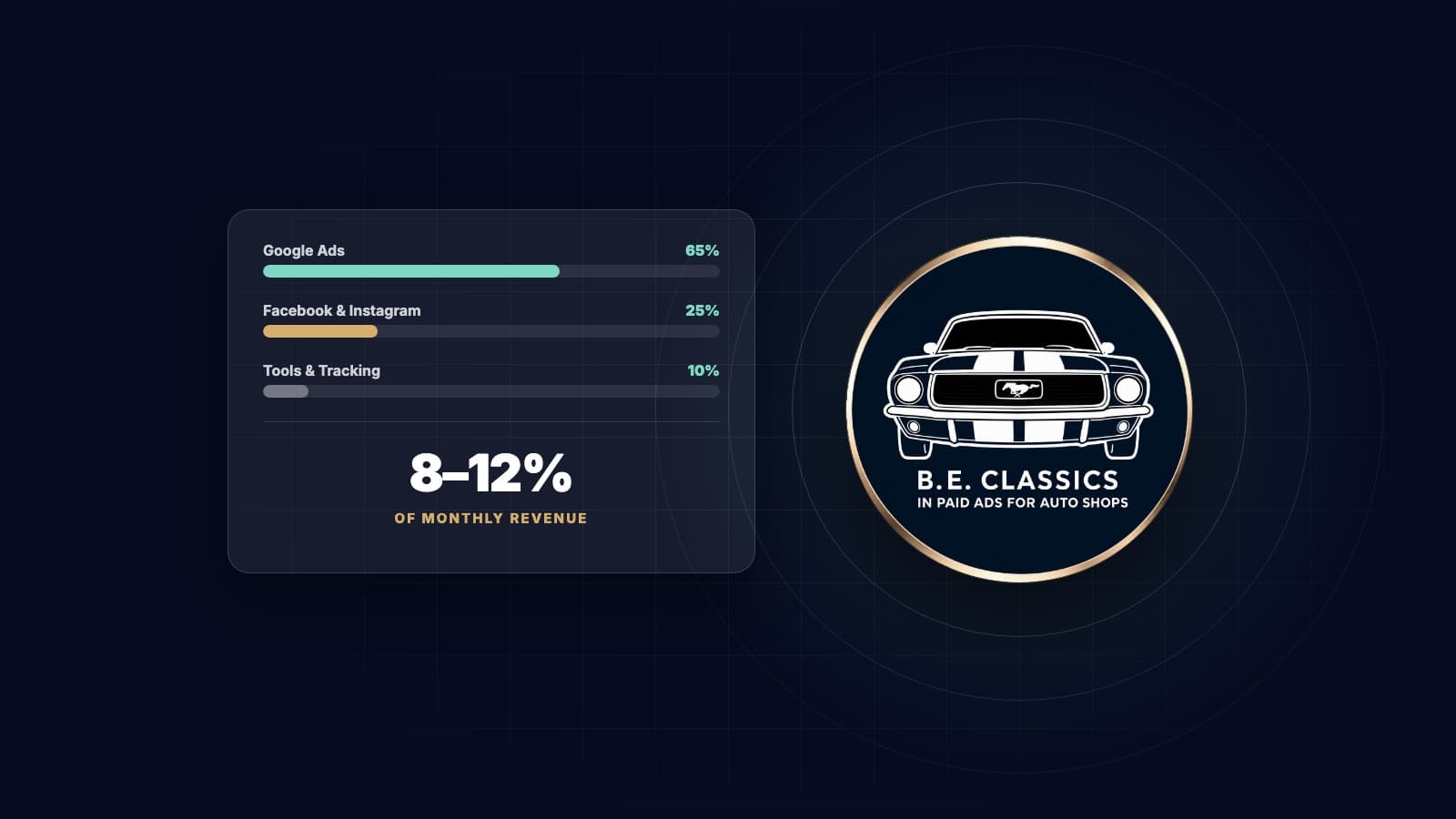
A common starting benchmark for small businesses is 5% to 10% of revenue spent on marketing. For an auto repair shop actively trying to grow, not just maintain what you already have, 8% to 12% tends to be a more realistic range.
So a shop doing $600,000 a year in revenue might reasonably spend $4,000 to $6,000 a month on marketing. That's a starting point, not a rule carved into a lift. Your shop's numbers get the final say, not a blog post.
A few things that should push that number up or down:
- New shop, or a shop with open capacity? Lean toward the higher end. Empty bays cost you every single day they sit empty, and marketing is what fills them, not vibes.
- Already booked out weeks in advance? Lean lower, or shift the budget toward your highest-margin services instead of general growth. More leads doesn't help if you can't get to the cars you already have.
- Seasonal swings? Push harder before your slow season hits, not during it. Trying to out-advertise a slow month once you're already in it is a much steeper climb.
Why "percentage of revenue" beats a flat number
A lot of advice online just gives you a flat dollar figure, "spend $2,000 a month," as if every shop has the same size, the same margins, and the same competition, which is a bit like prescribing the same brake pads for a sedan and a tow truck. A shop doing $2 million a year spending $2,000 a month is barely advertising. A shop doing $200,000 a year spending the same amount might be overextending itself. Tying your budget to your own revenue keeps it proportional to what you can actually afford, whether you're a one-bay operation or a five-location group.
How to split it across channels
Once you know your total number, the next question is where it goes. As a starting point for a shop actively trying to grow:
- 60-70% to Google Ads, since it captures people who are actively searching and ready to book, the fastest path to a return.
- 20-30% to Facebook and Instagram Ads, for staying visible before the need hits and for maintenance reminders.
- The rest toward tools that support both, like call tracking or a better landing page, since a great ad sending people to a slow website is money quietly wasted.
This isn't a fixed formula, once you can see your ROAS on each channel, that's what should actually steer the split, not a percentage someone wrote in a blog post.
The two mistakes that waste the most money
Spending too little to actually see results. Ad platforms need some volume to learn who's converting and optimize toward them. A budget so small it produces three clicks a day never gives the system, or you, enough data to know if it's working.
Spending a lot before anything's been proven. The opposite mistake is just as common: doubling the budget on a campaign that hasn't been tested yet, hoping more spend fixes a targeting problem. It usually doesn't, the same way revving a stuck engine harder has never once freed it. Prove a campaign works at a modest budget first, then scale the ones that are actually producing appointments.
A simple way to set your first number
- Take your monthly revenue and multiply by 8% as a starting point.
- Run it for at least a month, long enough to gather real bookings, not just clicks.
- Calculate your ROAS using last month's numbers.
- Adjust from there. A strong ROAS means there's room to spend more. A weak one means fixing the campaign matters more than adding more budget to it.
Want a second set of eyes?
Figuring out the right number, and then actually spending it well, is exactly what we do all day. B.E. Classics builds and manages Google and Facebook campaigns exclusively for auto repair shops, with clear reporting on what your spend is producing, and no long-term contracts.
If you'd like a free look at what a realistic budget looks like for your shop, book a free Google audit below.