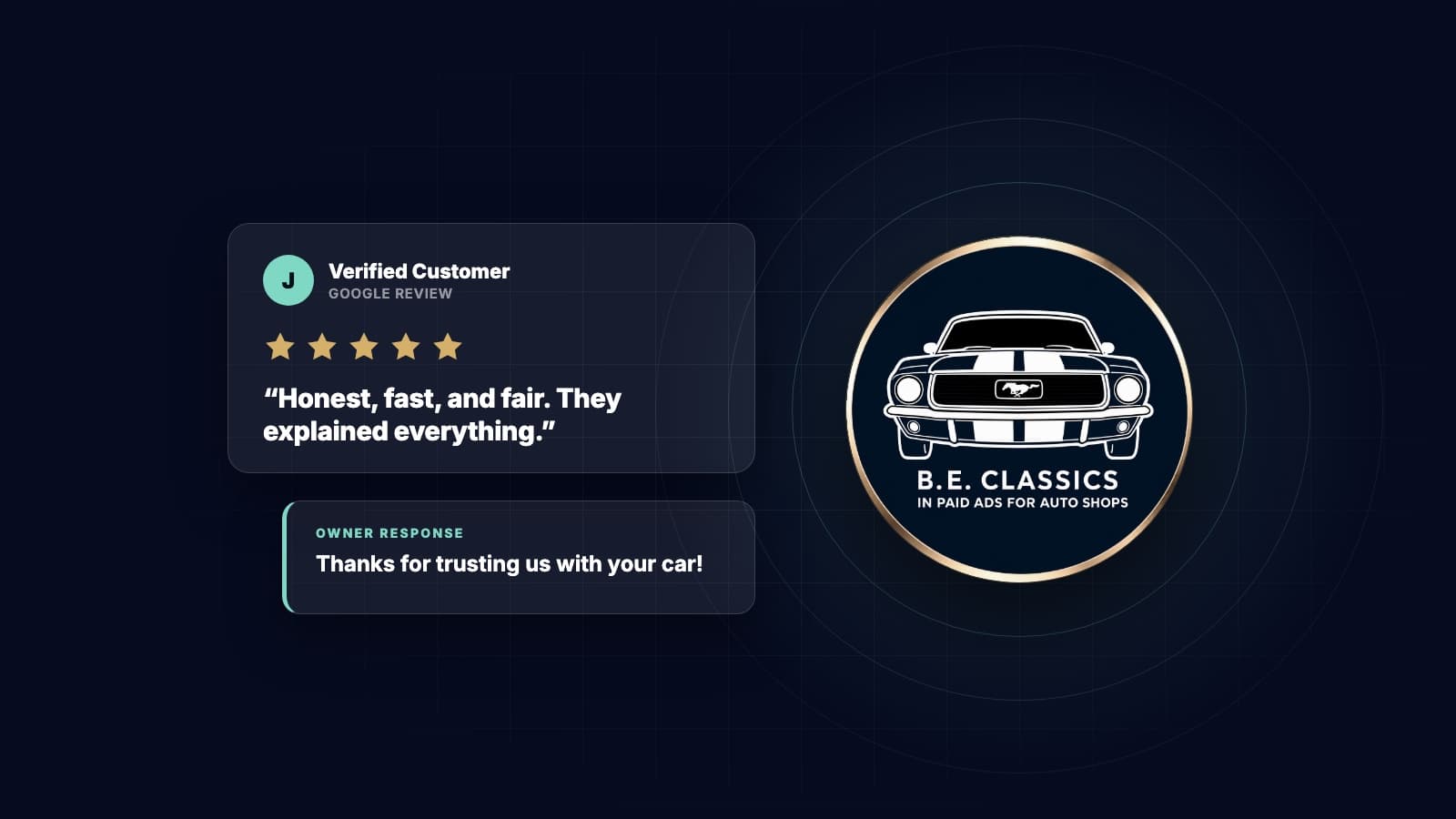
Great work in the bay doesn't count for much if nobody online can see it, which is a frustrating thing to learn after you've spent an hour explaining a CV joint to someone. Reviews are the one piece of proof a stranger can check before they ever pick up the phone, and for an auto repair shop, where trust is basically the whole sale, that makes them one of the highest-leverage things you can spend ten minutes a day on.
Here's how to get more of them, what to do when one shows up angry, and how to reply without sounding like it was written by a lawyer.
Why reviews matter more for auto shops than almost anyone else
Most people don't know a strut from a sway bar, and that's fine, that's what they're paying you for. When they're choosing a repair shop, they can't judge the work itself, so they judge the reviews instead. A shop with 150 recent, detailed reviews reads as safe. A shop with six reviews from three years ago reads as a gamble, even if the actual work is identical.
Reviews also feed your visibility. Google factors review count, rating, and recency into who shows up in the map pack, the block of three businesses shown above the regular search results. More reviews, kept current, tends to mean more visibility, which means more reviews. It compounds, which is a rare thing to say about anything involving a customer feedback form.
How to get more reviews without being annoying about it
The biggest reason most shops don't have many reviews isn't unhappy customers. It's that nobody asked. People are generally willing to leave a review for a business that did right by them. They just need a nudge and a link that doesn't make them dig for it.
- Ask at the moment of pickup, when the car's fixed and the customer's relieved, not three weeks later in a bulk email they'll ignore.
- Send a direct link, not just "leave us a review." A link that drops them straight onto the review box turns a two-minute chore into a fifteen-second favor.
- Text it, if you can. Text messages get read far more often than email, and most people are already holding their phone at checkout anyway.
- Ask every time, not just after the big jobs. An oil change customer is just as capable of leaving a five-star review as someone who just paid for a transmission rebuild.
- Never offer to pay for reviews or trade discounts for them. It's against Google's rules, it can get your listing penalized, and readers can smell it anyway.
A shop that asks consistently, even with a low percentage of customers actually following through, will out-pace a shop that never asks at all.
What to do about a bad review
Every shop gets one eventually, even the good ones. How you handle it in public tends to matter more than the review itself, because everyone reading it is really watching how you handle problems, not just judging that one bad day.
- Don't respond angry. Read it, walk away, come back in an hour. Nobody has ever written a good review reply at 11pm.
- Be curious, not defensive. A reply like "we'd like to understand what happened, please call the shop" reads far better than a reply arguing the details in public.
- Take specifics offline. Invite them to call or email, rather than litigating the repair order in the comments.
- Keep it short. A long, detailed public rebuttal usually looks worse than a short, calm one, even when you're right.
- If it's fake or clearly not a real customer, you can report it to Google for removal, but don't count on that working quickly, Google's patience for reading nuance rivals that of a customer whose check engine light just came back on. Respond publicly in the meantime.
One thoughtful reply to a bad review, visible to everyone who reads it after, can do more for your reputation than the bad review did damage.
A few real reply examples
Positive review reply: "Thanks for taking the time to write this, [Name]. Glad we could get you back on the road, and we appreciate you trusting us with it."
Negative review, legitimate complaint: "We're sorry to hear this, [Name]. This isn't the experience we aim for. Please give us a call at [number] so we can make it right."
Negative review, seems exaggerated or unfair: "We're sorry you're unhappy, [Name]. We'd like to understand what happened, our records show [brief factual note if relevant]. Please reach out at [number] so we can talk it through."
Keep the tone the same either way: calm, brief, and inviting a real conversation instead of having one in public.
Where to start this week
- Set up a direct review link (Google Business Profile → "Ask for reviews" gives you a shareable link).
- Ask your next ten customers at pickup, out loud or by text.
- Reply to every review you have right now, even the old ones. It's never too late.
- Write down two or three reply templates so you're not starting from scratch every time.
Want a second set of eyes?
Reviews are one piece of a bigger picture, alongside the ads and search visibility that actually get people looking at your shop in the first place. B.E. Classics builds Google and Facebook campaigns exclusively for auto repair shops, with clear reporting on what's working, and no long-term contracts.
If you'd like a free look at your shop's online reputation and marketing, book a free Google audit below.